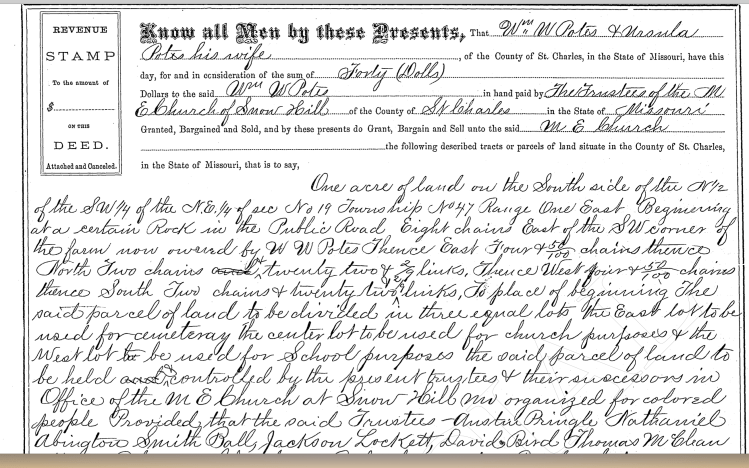
In 1871, several freedom seekers who had fought in the U.S. Colored Troops in the Civil War had returned home. These resilient men, would pool their funds, and establish an African Methodist Episcopal Chapel, with a Circuit rider preacher, that spread the gospel between St. Charles and Jonesburg at that time, and name it Smith Chapel. They would purchase one acre of land from another Union soldier, a German man from Ohio named William Potes, and his wife Ursala, for forty dollars. They would establish that one-third of that acre would be used for the Chapel, one-third would be for the cemetery to bury their loved ones, and one-third would be for the establishment of a schoolhouse named Douglass for their children.
The Smith Chapel Cemetery is an African American burying ground established by nine formerly enslaved individuals in St. Charles County Missouri. At least three men were freedom seekers, and members of the Smith Chapel African Methodist Episcopal Church associated with this graveyard. The cemetery is final resting place for Smith Ball (1833-1912), Benjamin Oglesby (1825-1901), and Martin Boyd (1826-1912) who each took steps toward freedom and joined the United States Colored Troops, despite the risks involved for themselves and their families. Living in a border state, these families were caught between the conflict of both Union Troops and Confederate guerilla soldiers. Under Martial law, many Missourians strongly opposed the formation of Colored Troops, only allowing those enslaved to serve as substitutes in their place and to fill County quotas. These freedom seekers, like many others, escaped slavery by the underground railroad, enlisting without permission. Slave Patrols, who kept constant watch of the roads for those attempting freedom, would either return those seeking their freedom to their former enslaver or enforce methods of punishment, which could include death. After the war, these men returned to their families to join others in creating this community.

Today, the cemetery is loved and maintained by a community of members from the neighboring Wesley-Smith Chapel in Wright City Missouri. The Cemetery is listed on the National Underground Railroad Network to Freedom and has received a grant for signage for the cemetery, and repair to broken and fallen headstones. Students from the St. Charles Community College are working to collect oral histories and family photos associated with the property.
The first church building built in the mid-1800s fell victim to a fire sometime in the late 19th Century. The original schoolhouse named Douglass School, that had been built by 1870, was replaced in the early 1900s. By the end of the 20th Century the schoolhouse, which had not been used since desegregation in the early 1960s, had fallen into disrepair and was being vandalized. That school building was used to re-erect a Douglass Schoolhouse which is in St.Charles County Parks system now. Located in Ogelsby Park, one mile from the cemetery, is the former Oglesby farm, a freedom seeker and a member of the Smith Chapel Church who is buried at Smith Chapel Cemetery. Both Ogelsby Park and the Smith Chapel Cemetery are listed on the National Underground Railroad Network to Freedom.


Your message has been sent

 Smith Chapel Cemetery