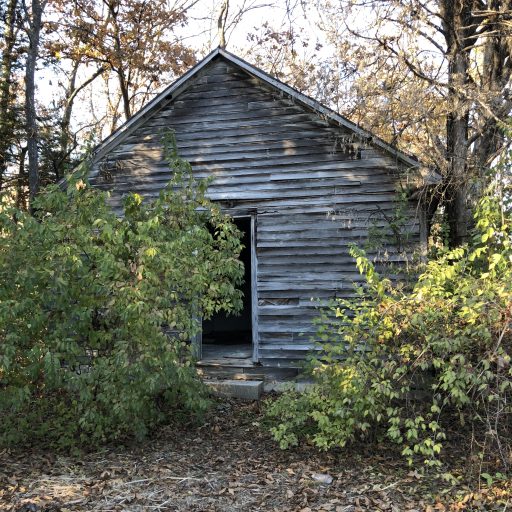
In 1871, when the Trustees established the Smith Chapel AME Church, they also established the Douglass Schoolhouse for their children. The Schoolhouse has been removed to Oglesby Park, and is now part of the St. Charles County Parks in Wentzville, Missouri.
Due to unfortunate circumstances, the Memorial Day ceremonies planned for May 27th, 2024 have had to be postponed.
Memorial Day was formerly known as Decoration Day when families would visit the graves of their loved ones and honor those who have served our country. Both heroes and those unknown, we use this day to recognize their contributions. Young, old, black, white, and even those who were foreign-born, they answered the call and gave the ultimate sacrifice to make this day possible. As we place our flags and our memorials to their lives, let us not forget their stories.
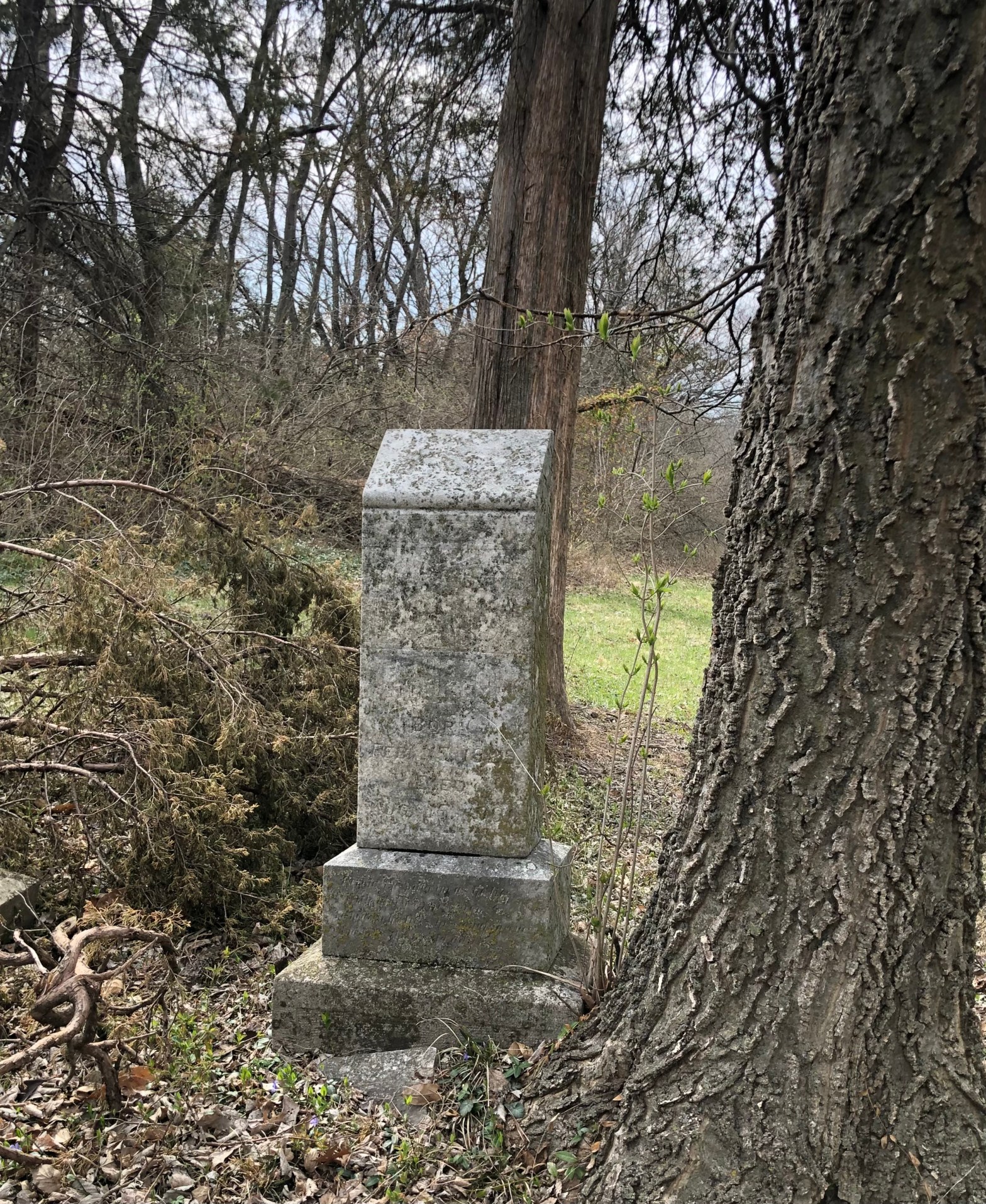
In St. Charles County, Missouri, Smith Chapel Cemetery is a small cemetery on one-third of the one-acre parcel of land, that was established in 1871, by several African American families, along with the Smith Chapel A.M.E. Church, and a schoolhouse named Douglass. The cemetery, though small, is filled with stories. At least six of the 115 graves that are located there are veterans of the U.S. Colored Troops who served in the Union in the Civil War. And as at least half of those were freedom seekers, who defied their enslavers and risked their lives, to enlist and serve in the Union Army. And, because of this, Smith Chapel Cemetery is now listed on the National Underground Railroad Network to Freedom. This National Parks program lists over 750 sites across our country that “consists of sites, locations with a verifiable connection to the Underground Railroad; programs, with educational and interpretive programs that pertain to the Underground Railroad; and facilities, either research, educational or interpretive centers.” Today we honor Smith Ball, Martin Boyd, and Benjamin Oglesby, as we honor all our heroes this Memorial Day.
On Sunday, February 28, 1864, thirty-one-year-old Smith Ball made his way from one end of St. Charles to the other, about 25 miles, and to freedom. The Ball farm was located at Flint Hill, also in Cuivre Township, a community just over seven miles east of Snow Hill, today’s Foristell. He would muster in at Benton Barracks in St. Louis like hundreds of other troops and serve in Company B of the 68th US. Colored Troops. He was one of the original Trustees of Smith Chapel and is buried there.
On October 31, 1864, freedom seeker Martin Boyd, left the 300-acre plantation of Alexander Boyd and tried to make his way to George Senden’s store on Main Street in St. Charles, only to make seven miles to the Peruque Creek Fort at the Missouri Railroad Bridge. Nearly caught, the young man was anxious to serve in the Union Army. He would serve in Company B of the 49th United States Colored Troops, until March 22, 1866. Boyd was also a Trustee of Smith Chapel and is buried there.
On November 14, Benjamin Oglesby and several other St. Charles County slaves left their owners and enlisted in the U. S. Colored Troops at George Senden’s store on Main Street, in what was known as “the Rendezvous”. This was part of the Union Army’s campaign in 1864 to recruit Missouri’s fugitives, refugees, and contraband into the Union’s ranks. That day it also netted over 30 men and freedom seekers from the nearby Hopewell Baptist Church. Oglesby was formally mustered into Company D as a Private of the 56th Infantry of the Union’s U.S. Colored Troops, at Benton Barracks. Unlike over 175 fellow soldiers from the 56th, Oglesby would return to his wife and family, and be buried at Smith Chapel. His son-in-law, Jackson Luckett was also one of the original trustees, that would build the Douglass schoolhouse for their children.
The 56th U.S.C.T. would see action in expeditions that took them from Helena, Arkansas up the White River to Friar’s Point, Mississippi. They had post and garrison duty at Helena, Arkansas till February of 1865. After the war ended, they continued to have duty at Helena till September 1866, when they assisted the local families, who were Quakers, build Southland University. The entire regiment was finally completely mustered out on September 15, 1866. The Regiment lost four Officers and twenty-one enlisted men who were killed or mortally wounded, and they lost two Officers and 647 Enlisted men by disease.” Many of those died going home, like George [Granville] Abington, (ancestor of another George Abington, his namesake) who was buried first at Quarantine Island and then moved to Jefferson Barracks National Cemetery. For more about the 56th USCT see https://www.facebook.com/56USCT online.
Let us not forget the true meaning of this day, and the hardships and sacrifices of those who have served our country, in peacetime and in war, and allow us to celebrate their lives. For more about the National Underground Railroad see https://www.nps.gov/subjects/undergroundrailroad/network-to-freedom.htm for more information. Douglass Schoolhouse is now located in St. Charles County Parks and is also on the National Underground Railroad Network to Freedom.
On April 22, 2024, the National Park Service announced that they have added new listings to the National Underground Railroad Network to Freedom and Smith Chapel Cemetery located in Foristell, in St. Charles County Missouri is one of the four new listings found in Missouri.
Smith Chapel Cemetery, an African American cemetery in Missouri, was established in 1871 and is the resting place of freedom seekers who fled from their enslavers and served in the U.S. Colored Troops. In 1864, Smith Ball (1833-1912) escaped to St. Charles on February 28th and enlisted in the 68th U.S. Colored Troops. Benjamin Oglesby (1825-1901) fled his enslaver and enlisted on November 14, 1864, in the U.S. 56th U.S. Colored Troops. On October 31, 1864, Martin Boyd (1826-1912) took steps towards freedom and joined the Union troops guarding Fort Peruque, enlisting in the 49th U.S. Colored Troops. After the Civil War, upon returning home to their families, these veterans along with Oglesby’s son-in-law Jackson Luckett, Nathaniel Abington, Austin “Oss” Pringle, David Bird, Thomas McClean, Mark Robinson, and Claiborne Richards, were the first Trustees of the Smith Chapel African Methodist Episcopal Church at Snow Hill. This one-acre of land included a one-room black schoolhouse named Douglass and a small Church building for worship. Though the schoolhouse has been relocated to Oglesby Park, and the church building no longer stands, Smith Chapel Cemetery remains an important landmark for many of the descendants of the freedom seekers and their families today.
Beginning in the 17th century and continuing through the mid-19th century in the United States, enslaved African Americans resisted bondage to gain their freedom through acts of self-emancipation. The individuals who sought this freedom from enslavement, known as freedom seekers, and those who assisted along the way, united together to become what is known as the Underground Railroad. The National Park Service and members of the Network to Freedom tell these stories of escape to demonstrate the significance of the Underground Railroad in the eradication of slavery as a cornerstone of the national civil rights movement.
Buried at Smith Chapel A.M.E. Cemetery in Foristell is Smith Ball, one of the nine Trustees who helped start the A.M.E. church in 1871.
On Sunday, February 28, 1864, thirty-one-year-old Smith Ball had made his way from one end of St. Charles County to the other, a distance of about 25 miles, to reach freedom. His enslaver was John Ball who had passed away in 1850, leaving fifteen enslaved people living in three small cabins on his widow, Ann Hitch Ball’s large tobacco plantation.[ii] The Ball farm was located at Flint Hill, also in Cuivre Township, a community just over seven miles east of Snow Hill.
Smith Ball had been born May 26, 1833[iii], in Virginia, and had been brought to Missouri during the 1830s. According to his enlistment papers, he was a light-colored black [man], 5 foot 10 inches tall, with brown eyes and black hair. When he enlisted, he left behind a wife Minerva Pringle, and four children, William, Lucy, John H., and Ada. When mustered in at Benton Barracks, he was examined by John Bruere, MD. of Benton Barracks in St. Louis like hundreds of other troops. He served in Company B of the 68th US. Colored Troops. [iv] The remarks on the Descriptive list stated “Recruit presented himself” meaning that he had fled his enslaver, Ann Hitch Ball(1804-1870), the widow of John P. Ball (1805-1858)[v].
Notes
[ii] 1850 U.S. Federal Census – Slave Schedules Record, United States of America, Bureau of the Census. Seventh Census of the United States, 1850/i. Washington, D.C.: National Archives and Records Administration, 1850. M432
[iii] MO Secretary of State, Bureau of Vital Statistics, Death Certificate of Smith Ball, Sept. 13, 1912.
[iv]Compiled Military Service Records of Volunteer Union Soldiers Who Served the United States Colored Troops: 56th-138th USCT Infantry, 1864-1866; NARA; 300398; Carded Records Showing Military Service of Soldiers Who Fought in Volunteer Organizations During the American Civil War, compiled 1890 – 1912, documenting the period 1861 – 1866
[v] The 1860 U.S. Federal Slave Schedule for Ann Ball, Cuivre Township, St. Charles County.
On October 31, 1864, freedom seeker Martin Boyd, born in 1826, left the 300-acre plantation of Alexander Boyd and tried to make his way to George Senden’s store on Main Street in St. Charles, only to make it as far as Peruque Creek Fort at the Missouri Railroad Bridge. There Capt. L.D. Jay would enlist the 5’9” black man into the U.S. Colored Troops. Later, Alexander Boyd tried to show proof that he had inherited Martin from his mother Ruth Carr Boyd, widow of William Boyd, and that Martin Boyd was his property, and was seeking compensation for Martin’s Services and that as such he was entitled to a $300 bounty. Alexander did not receive it. Freedom seeker Martin Boyd would serve in Company B of the 49th United States Colored Troops, until March 22, 1866. That December 31st, 1866, he would marry Mandy (is this Amanda?) Logan, as Black Marriages were now legal.
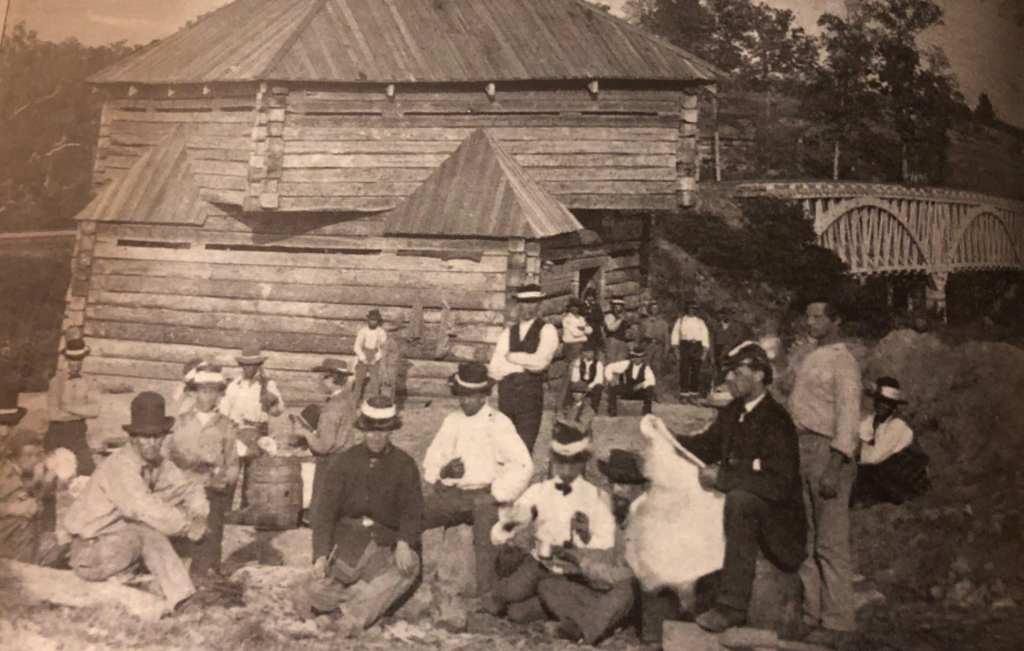
Union Troops at Fort Peruque on the North Missouri Railroad
Born on the Boyd Plantation – Now Towne Park in St. Charles County Parks
In 1827, Missouri was a new state filled with opportunity, at least for some people. Those living in Maryland, Kentucky, and Tennessee saw the opportunity and seized upon it. The land was selling for $1.25 an acre or if it already had “improvements” a man could get at least $2 per acre. And Dardenne and Cuivre Townships of St. Charles County were huge prairies where the crops of tobacco and hemp could make a man richer than his wildest dreams. William Boyd from Shelby County Kentucky had such a dream when he investigated it, but would die in 1830, before he could fulfill it, leaving behind his wife of 32 years, Ruth Carr, mother of his 11 children. When Ruth’s father died in 1832, she brought her children and joined her brother James and his wife Susanna, who had already settled in Flint Hill. With Ruth was her 10-year-old son Alexander Thomas Boyd and at least eleven enslaved individuals.
In 1840, Mrs. Boyd, now living in Cuivre Township, had 14 enslaved individuals living here and working on her plantation. By 1850, the number of these enslaved individuals had grown even larger to 17 African Americans living on the Boyd plantation. The youngest is now an 11-month-old boy, and the oldest is now a 44-year-old woman, among the 8 females and 9 males on the tobacco farm. Unfortunately, the 1850 Census taker did not take the number of buildings there were to house these individuals, and their names were never given. The accounting of this is all based on an honor system, for tax purposes only.
By 1860, Ruth Boyd 78-year-old mother of Alexander Boyd, is living with her son, next to her son Thomas, on the Boyd family plantation. Ruth is the enslaver of 7 people living in two cabins, Alexander has 8 people living in one cabin, and Thomas has 7 people as well living in two cabins. In all, this Flint Hill tobacco farm has 22 enslaved people living in 4 cabins, which range from a pair of 5-month-old twin girls to a couple of women who are estimated to be 30 years old. No, the 1860 Federal Census, never gives us names of all of these people. But according to records, St. Charles County Park historian Ben Gall shares the names of 14 of these 22 people. They are Martin, Amanda, Henry, Lucy, Thomas, Emeline, Ella, David, Maria, her daughter Maria, Rose, Joshua, George and Ruth. The Boyd Plantation is now Towne Park, part of the St. Charles County Park System.
In 1870, the United States Census revealed so much. Forty-eight-year-old Alexander T. Boyd, and his wife Ann Medora (McRoberts), are still living on the Boyd plantation, with their three children, Fannie aged 13, William aged 12, and 2-year-old Fenton. With them live white 26-year-old Henry Minor and his 30-year-old wife Mary, who works as a farmhand for Alexander. Martin lives on the plantation with his wife Mandy, and their 1-year-old son Samuel. In 1912, 86-year-old Boyd passed away and was buried in the Smith Chapel Cemetery.
STORIES OF SMITH CHAPEL CEMETERY
In 1871, several veterans of the U.S. Colored Troops returned home to their loved ones and began building a new life in freedom. Nine men, Austen Pringle, Nathaniel Abington, Smith Ball, Jackson Lockett [Luckett], David Bird, Thomas McClean, Mark Robinson, Claiborn Richards, and Martin Boyd would come together as trustees for the Smith Chapel A.M.E. in what is today’s Foristell. For $40, they purchased a small one-acre of land to start a school for their children named Douglass, build an African Methodist Episcopal Church named Smith Chapel for their families, and establish a cemetery for their loved ones. Of the over 115 burials in the Smith Chapel Cemetery, at least ten veterans of the U.S.C.T. Many of these men had been brought to St. Charles County, from Virginia and Kentucky. Some had been born here, some had families here, but all had been enslaved here. Many of them have families that still live here today.
In 1871, several formerly enslaved St. Charles County men returned home, as veterans of the U.S. Colored Troops of the Union Army, and began building a new future for their families. For $40, they purchased a small one-acre of land from a German veteran, to start a school for their children named Douglass, build an African Methodist Episcopal Church named Smith Chapel for their families, and establish a cemetery for their loved ones. Of the over 115 burials that lie in the Smith Chapel Cemetery, there are at least ten veterans of the U.S.C.T. Many of these men had been brought to St. Charles County, from Virginia and Kentucky. Some had been born here, some had families here, but they all had been enslaved here. Many of them have families that still live here today.
On November 14, 1864, freedom seeker Benjamin Oglesby* fled Marshall Bird’s[i] farm[ii] at Snow Hill and made his way the thirty-five miles to St. Charles. Oglesby had been born in Bedford County, Virginia in about 1821 at the home of his mother’s enslaver, Marshall Bird. Benjamin was brought to Missouri by Bird as a young boy, around 1830. Bird’s farm was at the far western edge of the St. Charles County border with Warren County, near the Post Office called Snow Hill, which later became Foristell. He would work in the fields of Birds’ 100-acre farm, where like so many of Birds’ neighbors, the primary crop was tobacco. In 1860 the farm would produce over 7000 pounds alone. He left behind a wife named Martha*, whom he called Patsy, and together they would have eight children, Dora*, Mary*, Samuel,* Sarah*, Sophia*, Oska*, Albert*, and Belle* who were all born before November of 1864. There were two cabins on Marshall Birds’ tobacco plantation, and David Bird* occupied the other.
He enrolled at the age of 43, being copper-skinned, with grey eyes and black hair, and being 5 feet 8 inches tall. He was formally mustered into Company D as a Private in the 56th Infantry of the Unions’ U.S. Colored Troops at Benton Barracks (near today’s Fairground Park).[iii] His enrollment gives no evidence of Marshall Bird as ever applying for or receiving the $300 bounty. Oglesby’s Regiment was originally Third Arkansas and was the first black regiment recruited in Missouri; it had been raised as an “Arkansas” regiment to avoid offending loyal Missouri slaveholders. In March 1864, it had been re-designated the Fifty-Sixth United States Colored Infantry and sent to Helena, Arkansas. Conditions there were atrocious. Some of the regiment’s companies were sent to Island No. 63, about twenty miles south of Helena on the east side of the Mississippi. Helena was the site of a huge contraband camp, where thousands of formerly enslaved would find refuge during the Civil War. After the war ended, the 56th would help build and establish an African American University and an orphanage. Hiram Luckett, a relative of Benjamin Oglesby died there in a hospital on September 18, 1864, from chronic diarrhea. Many others serving in the U.S. Colored Troops would suffer the same fate.
His children, grandchildren, and future generations would attend Douglass School, a segregated African American schoolhouse, which has been removed to Ogelsby Park, part of St. Charles County Parks & Recreation.
Next: Smith Ball and the 68th U.S. Colored Troops
Sources:
[i] The 1860 U.S. Federal Slave Schedule on Page 5 lists Marshall Bird as owning eight enslaved individuals living in 2 buildings, which indicates that Benjamin and his wife Patsy and their children had their own cabin. See attached.
[ii]Marshall Bird Land Patent 1837, Bureau of Land Management General Land Office Records, Certificate #14734 of the U.S. Land Office shows that Marshall Bird also lived in Section 19, the NW ¼ of the NW1/4 of Sect. 19, Twnshp 47 North Range 1 East. See Attached
[iii] Oglesby, Benjamin National Archives and Records Administration Compiled Military Service Records of Volunteer Union Soldiers Who Served the United States Colored Troops: 56th-138th USCT Infantry, 1864-1866;



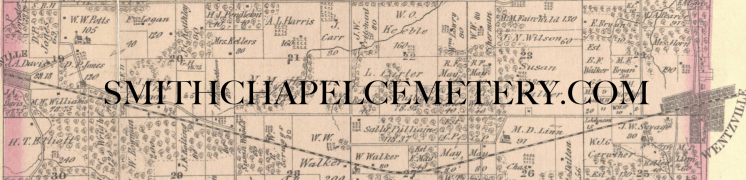
 Smith Chapel Cemetery