Featured

Restoring History

In 2024, a small one-acre of ground, in Foristell, Missouri, a special place called Smith Chapel Cemetery, which has been lovingly cared for since 1871, was listed on the National Parks Services’ National Underground Railroad. Because of that, they applied for and were granted by Congress, a grant to restore the cemetery by professional Cemetery Restorer, Jerry Prouhet and for historian, Dorris Keeven-Franke, working with Professor Grace Wade Moser at the local St. Charles County Community College and two semesters with over 75 students each semester, to help in the restoration, create Oral histories, write research on relative topics, and the people that are buried in the cemetery, and to help create four information signs. The four signs will identify the history of the property at the front gate, the former site of the one-room African American Douglass Schoolhouse, the site of the Smith Chapel A.M.E. Church, and the history of the Cemetery and are being paid for by the National Park Services grant.

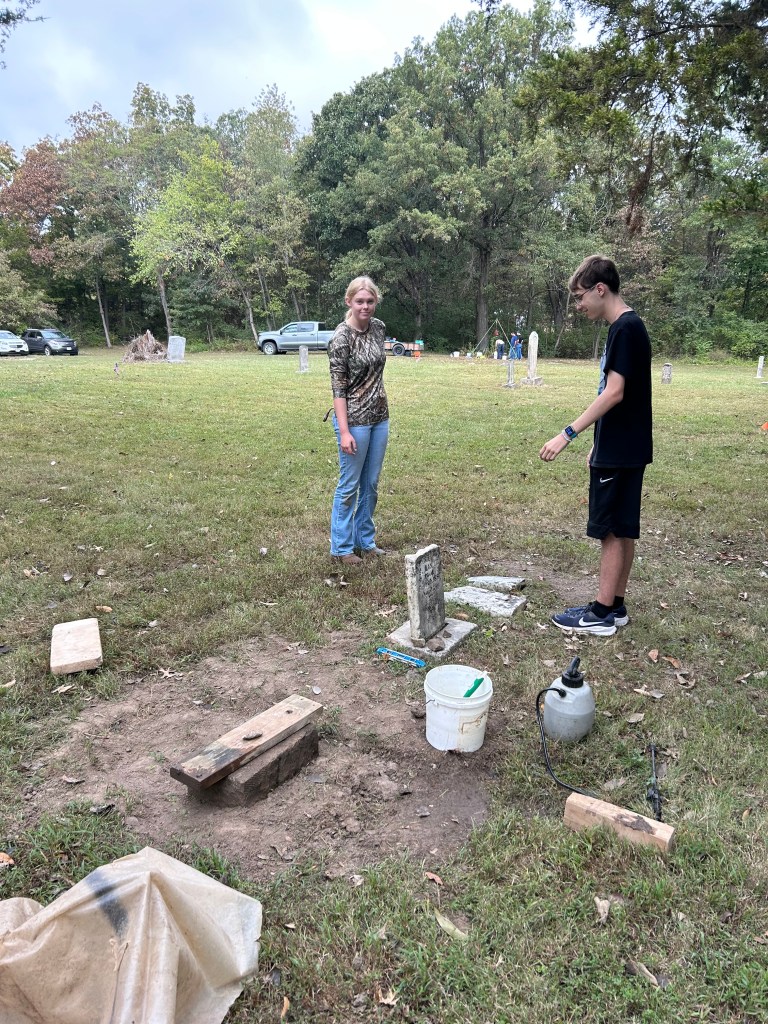
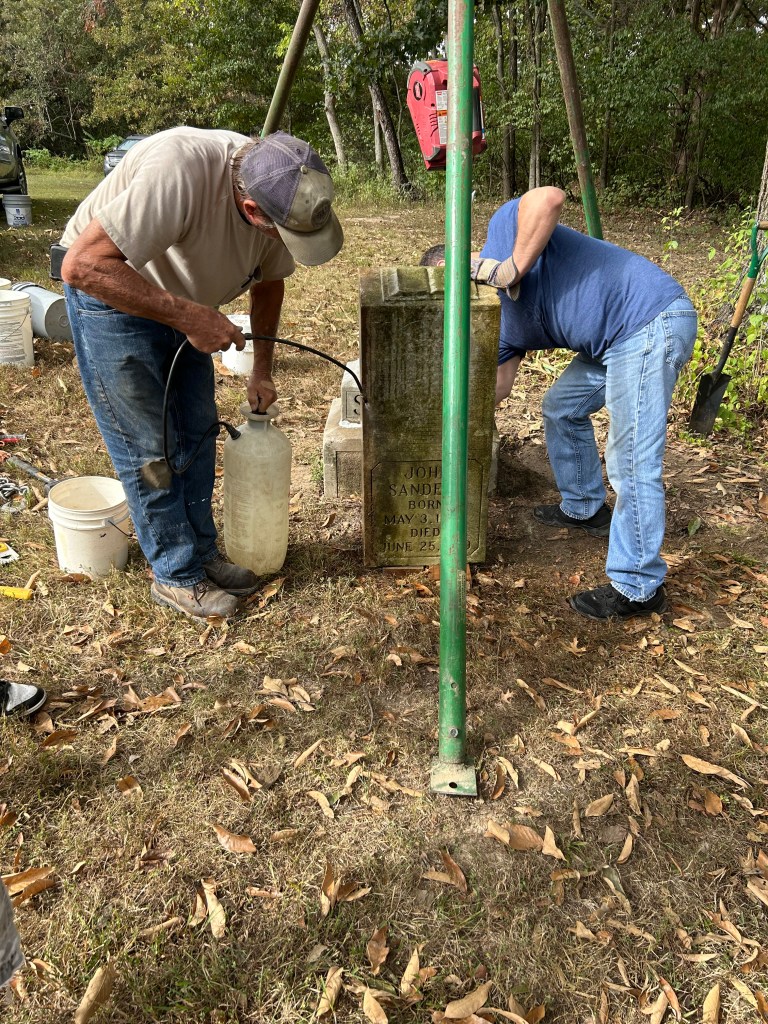
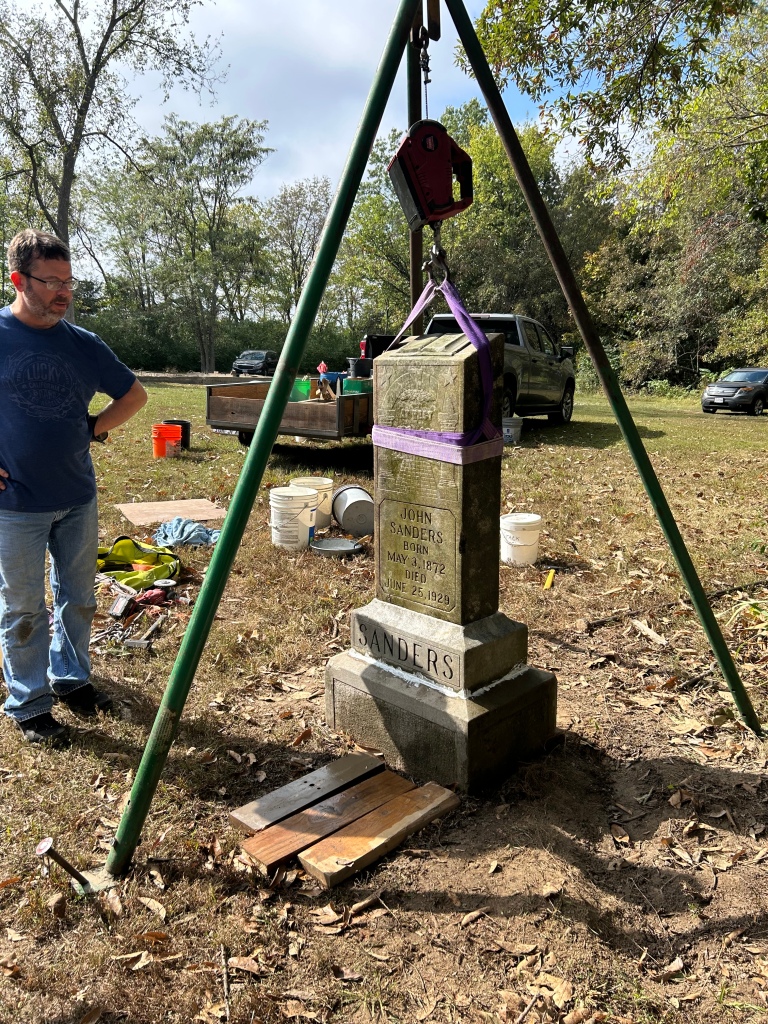
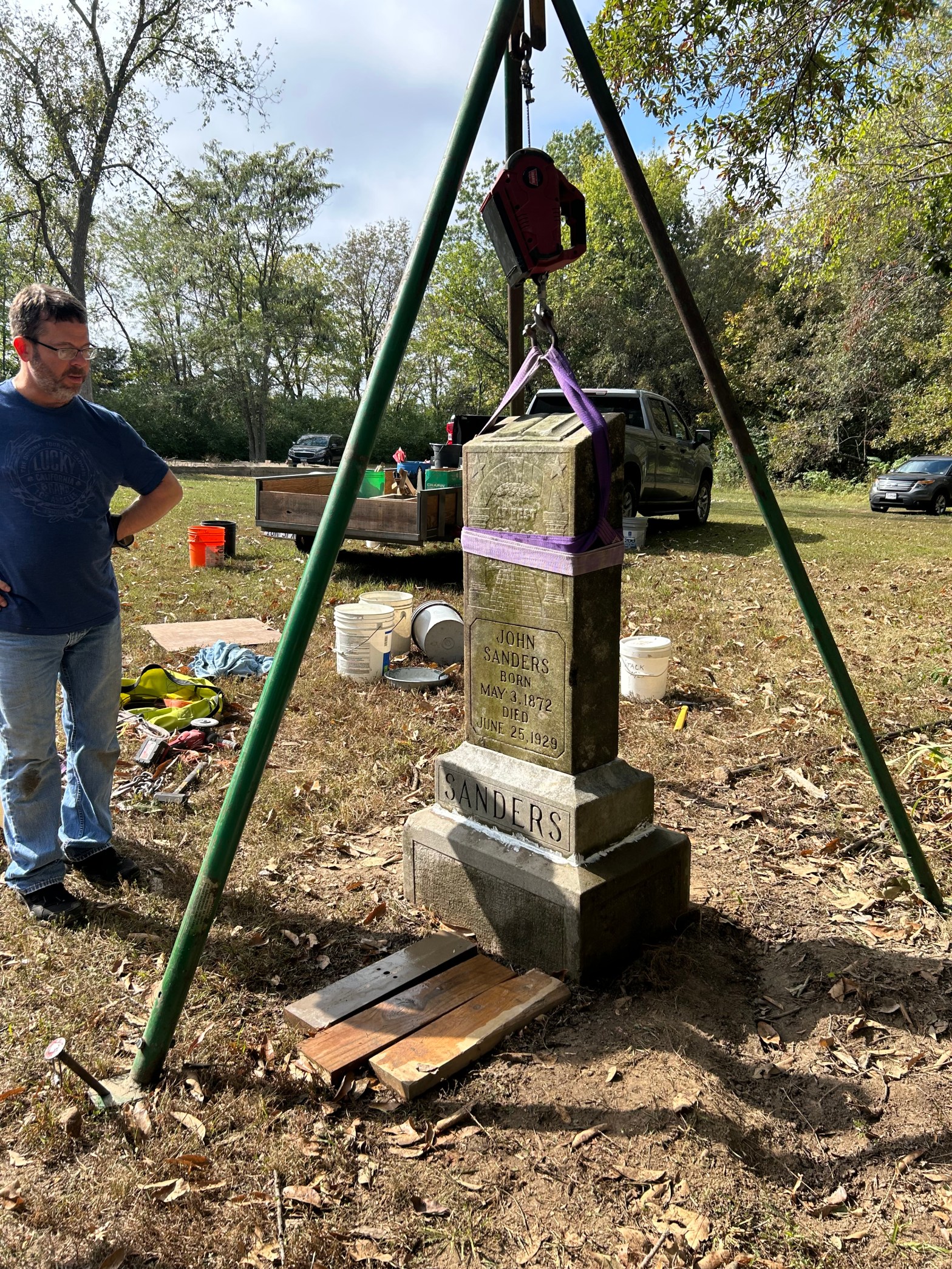
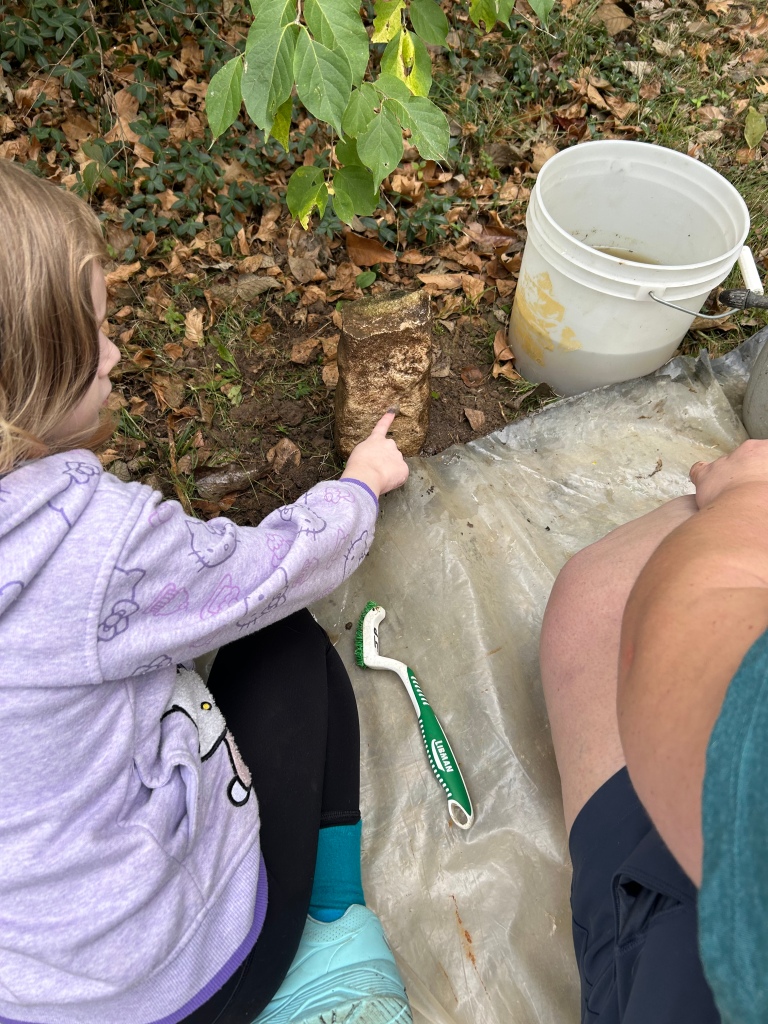
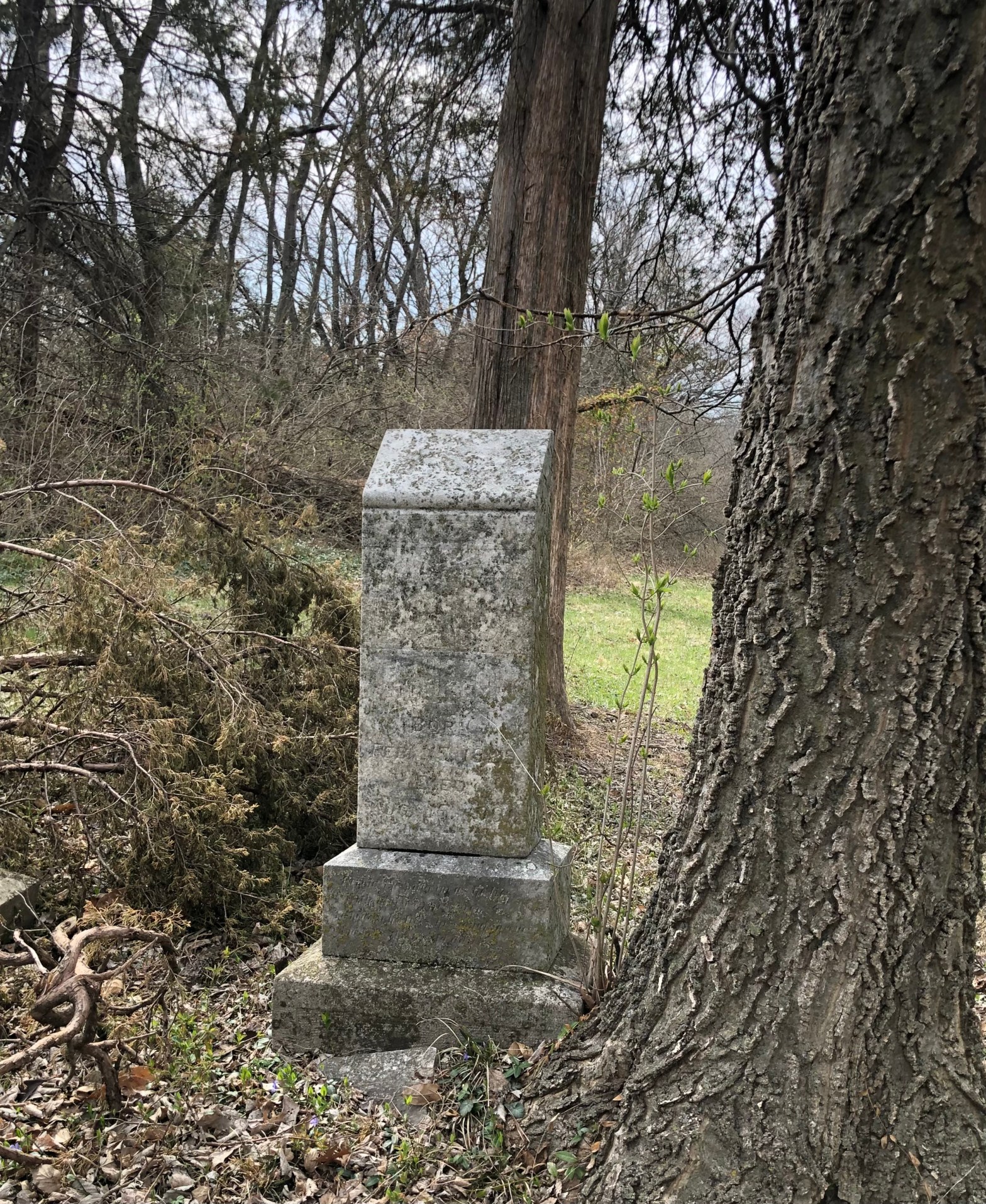
The students have spent hours tenderly cleaning headstones, locating fallen headstones, cleaning and pulling weeds, and recording history. This class, with Professor Moser, referred to as Service Learning, immerses the students in their local history in a way no regular history class ever can. The dates they study are the ones etched in stone, sometimes even concrete pieces that have placed to mark a loved one’s life. They have visited with the descendants, now members of the Wesley Smith Church on Hwy J in Wright City, because many of them are descendants of those buried at Smith Chapel. On October 11, 2025, the students and members of the community worked with Prouhet, Cemetery professional, to right the headstone of a man named John Sanders, who had been laid to rest in Smith Chapel Cemetery on June 29, 1929.

Sanders had died after a Crane accident from internal injuries at the St. Louis City Hospital on June 25th, leaving a wife named Pinkey, a widow. At the time of the accident, John was living in St. Louis, but would be brought home, and after funeral services by the Nieburg Funeral home in Wright City, laid to rest among other family members. He was the son of Price Sanders, and was born in Missouri on May 3, 1872 according to his headstone.

The stone had toppled and had been lying on the ground for well over 70 years, according to his descendant Bill Sanders, who was there to witness the restoration by Prouhet. Sanders is the caretaker of the Cemetery and has many relatives in the cemetery. The students are learning genealogy techniques as well; but information is scarce for African American families.  If you are interested in learning more about Smith Chapel Cemetery in Foristell Missouri, visit https://smithchapelcemetery.com/ online. They will be sharing more about this project at two programs in November, on Tuesday, November 18th at the Wentzville Historical Society; and Thursday, November 20th at the Warren County Historical Society.
Featured

Buried History, Uncovered Stories

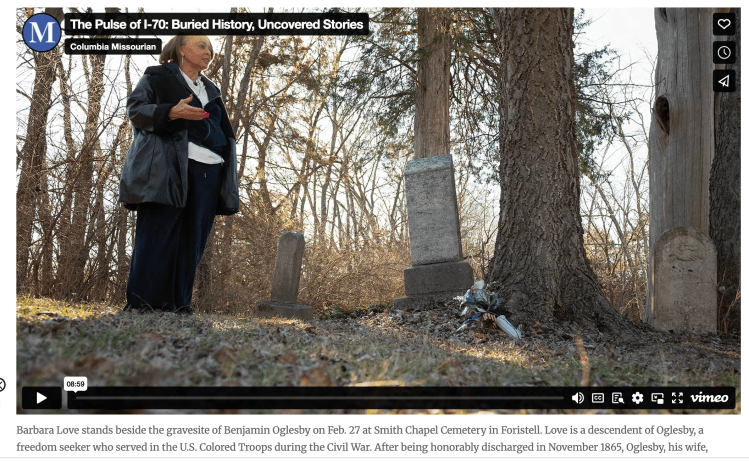
On a recent beautiful evening in August, friends, families, and the community came together to share their love for the historic St. Charles County landmark called Smith Chapel Cemetery. Established in 1871, it was listed on the National Underground Railroad Network to Freedom in 2024, because at least three freedom seekers: Benjamin Oglesby, Martin Boyd and Smith Ball lay in the small family graveyard. Then they received a Grant from the Network to Freedom to restore the small African American Cemetery, and place historical markers at the cemetery. Students of Professor Grace Moser of St. Charles Community College, are enrolled in her Service Learning American History Class, are doing research, writing and cemetery restoration work. Jerry Prouhet, a professional cemetery preservationist, works with the students and is restoring lost and overturned headstones.

In February of 2025, Audrey Pinson, a student from the University of Missouri School of Journalism, heard about the project and contacted Dorris Keeven-Franke, Project Director, wanting to know more. The result was a small documentary that tells a huge story! Interviews with Barbara Love, a descendant of Benjamin Ogelsby, and those working on the project share their love for this nearly forgotten cemetery that contains a lot of history. For those who were unable to join us, we would love to share!

Follow this link to the short video:

https://www.columbiamissourian.com/news/state_news/community-leaders-work-to-preserve-history-at-smith-chapel-cemetery/article_012883e1-bc4c-4b26-99b1-93108d0d998f.html

To subscribe and receive future emails about this project:

Follow us on Facebook

To Contact Us and get involved:

Go back

Your message has been sent

Warning
Warning
Warning
Warning.

Featured

FILM PREMIERE

BURIED HISTORY, UNCOVERED STORIES

In 2023, a small one-acre plot of land called Smith Chapel Cemetery was recognized by the National Park Service’s Program, the NATIONAL UNDERGROUND RAILROAD NETWORK TO FREEDOM, due to the resilience and courage of three enslaved men who were seeking their freedom using the Underground Railroad. In the winter of 1864, at the height of the Civil War, they would flee their enslavers and join the Union Army’s U.S. Colored Troops.

In 2024, the Wesley Smith Church in Wright City was granted funds for a project funded by the National Park Service’s NATIONAL UNDERGROUND RAILROAD NETWORK TO FREEDOM for the Smith Chapel Cemetery Restoration, to enable them to hire a professional Cemetery Restorer named Jerry Prouhet and for historian and writer Dorris Keeven-Franke to work with Professor Grace Moser and her students at St. Charles Community College. The students are taking the Service Learning Class American History 101 and 102 and are helping to research the signs that will be erected to tell the story of Smith Chapel.

In February 2025, these funds from the National Park Service were temporarily halted but later resumed. That’s when Journalism Students from the University of Missouri in Columbia became aware of the project, and wanted to learn more about the cemetery and its’ people. Join us on August 23, 2025, in Oglesby Park, 2801 W. Meyer Road, (St. Charles County Parks) in Foristell, from 6pm til Sunset as we premiere their documentary called BURIED HISTORY, UNCOVERED STORIES. The public is invited; this event is being held by those working on the cemetery, who want to share the story with everyone. The screening will be outdoors in the pavilion at the back of the Park near the Douglass Schoolhouse. Please bring lawnchairs. For more information, email stcharlescountyhistory@gmail.com

For more about Smith Chapel Cemetery, subscribe and receive an email when we post new stories…

Featured

May 24, 2025

There is now a sign at Smith Chapel Cemetery on Hwy W, in Foristell, MO. On Saturday May 24th, members of the community joined Cemetery Restoration professional Jerry Prouhet at the historic Smith Chapel Cemetery on Hwy W in Foristell, Missouri. There are three freedom seekers – Benjamin Oglesby, Smith Ball and Martin Boyd; two more U.S.C.T. veterans and one World War I Veteran buried in Smith Chapel Cemetery. We cleaned stones and attempted to straighten all of the Oglesby stones, and were somewhat successful. Thank you to all who came and helped us to honor these Veterans on this Memorial Day!!!

Featured

Student Recognition Day

In Foristell, Missouri, the Smith Chapel Cemetery, was begun by nine Trustees for the Smith Chapel AME Church established in 1871, was listed on the National Underground Railroad Network to Freedom in 2024. Now, students from St. Charles Community College, studying with Professor Grace Wade Moser are working to uncover the history of this small African American cemetery in western St. Charles County. In the cemetery, you find the graves of at least freedom seekers. Benjamin Oglesby (1825-1901) who fled enslavement in 1864, joined the 56th U.S. Colored Troops leaving behind his wife Patsy and several children. Smith Ball (1833-1912) who also resisted his enslaver and joined the U.S. 68th U.S. Colored Troops in 1864. Martin Boyd (1826-1912) escaped from the Boyd family’s plantation, and enlisted in the U.S. 49th U.S. Colored Troops at Fort Peruque. In 2025, the historic Smith Chapel Cemetery was awarded a National Park Service Grant, because of its listing on the National Underground Railroad’s Network to Freedom, providing funds for cemetery restoration work, and for four educational signs to be placed that will provide further information about the property, including the former site of the Douglass schoolhouse (which is now located in Oglesby Park and also on the National Underground Railroad Network to Freedom), the former site of the African Methodist Episcopal Chapel, and more importantly, the cemetery itself.
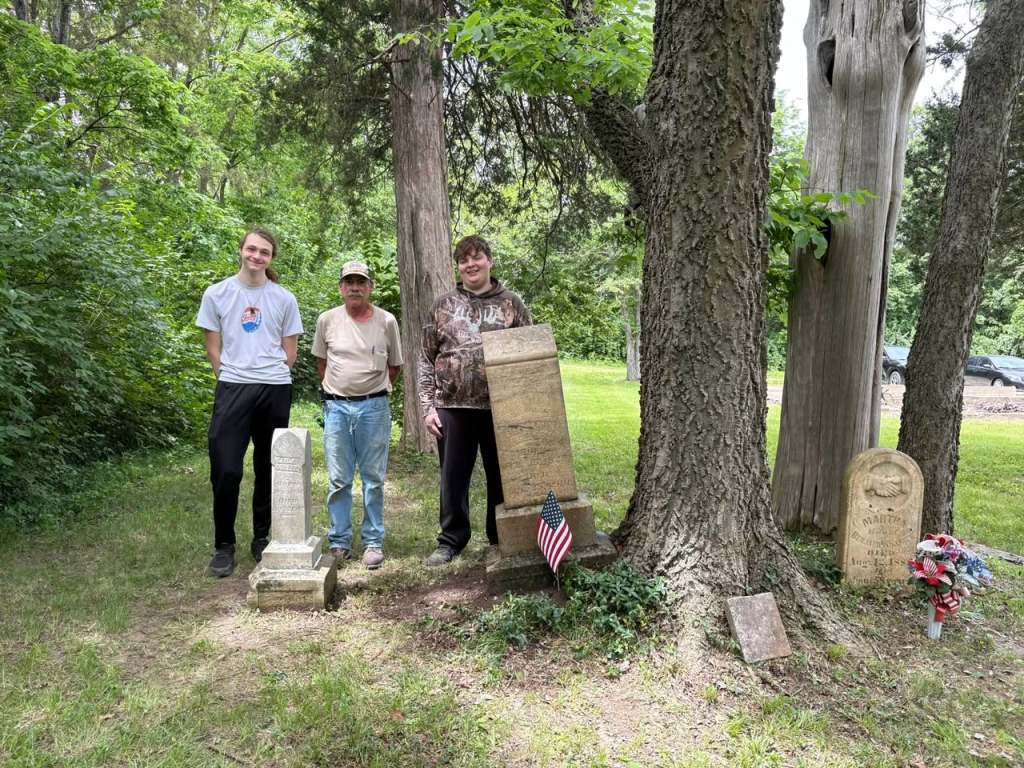
Local students from the St. Charles Community College working with Cemetery expert Jerry Prouhet

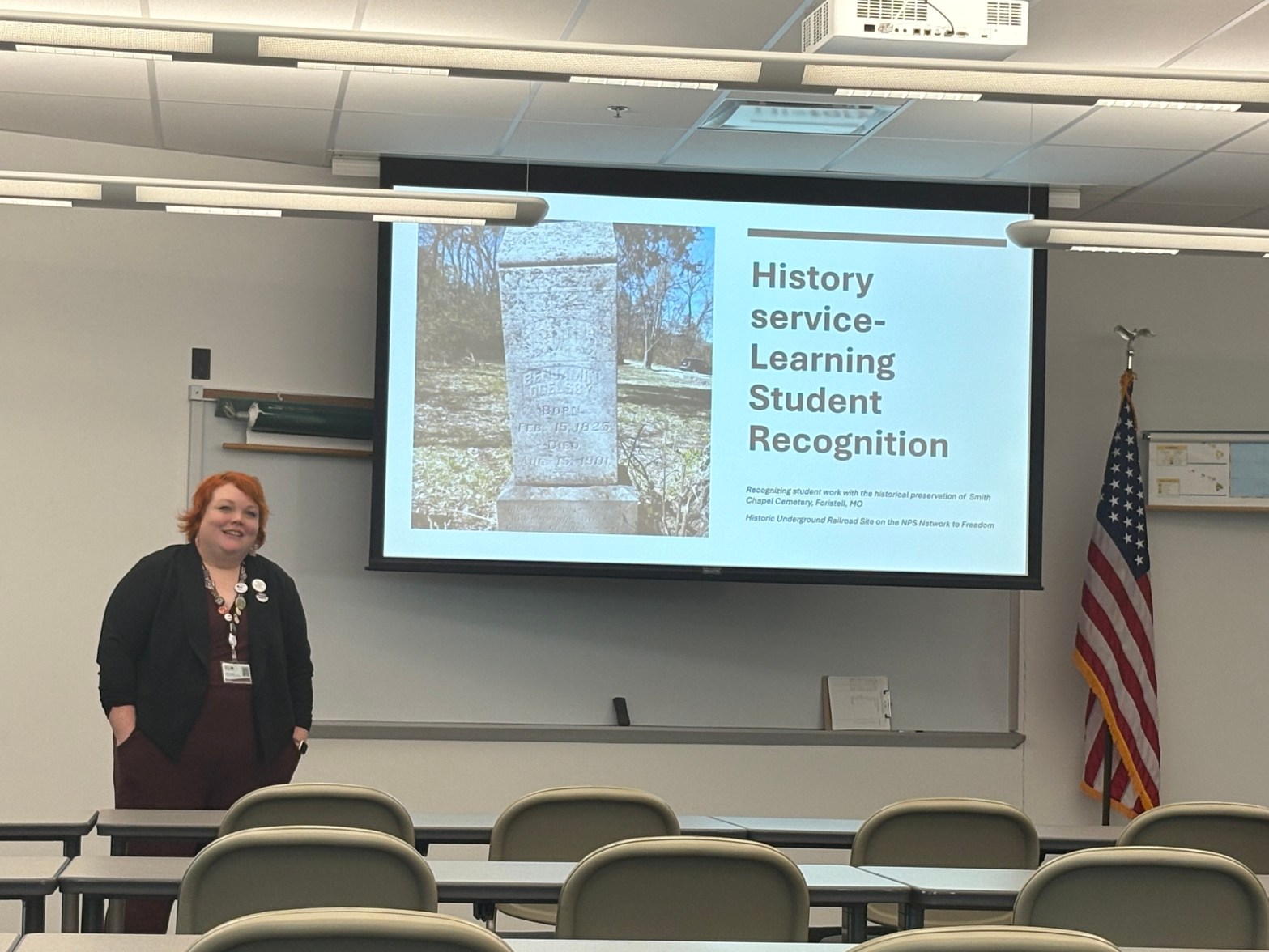
On Wednesday, May 7, 2025, The St. Charles Community College students taking Moser’s American History Class /Service Learning were recognized with a Student Recognition Day where they presented their fellow students, family members of Smith Chapel Cemetery, and the community, with stories about what they have learned. Several students shared their work with military records, death certificates, newspapers, and online family trees. Others shared their experience of recording Oral Histories and their time working directly in the cemetery with Jerry Prouhet, a professional cemetery restorer. They have had several workdays in the cemetery working to locate lost headstones, and righting broken and overturned headstones. The students’ research will be added to the website and shared at future events. More students taking the fall semester will be able to add to the wealth of knowledge that the Spring 2025 students began.

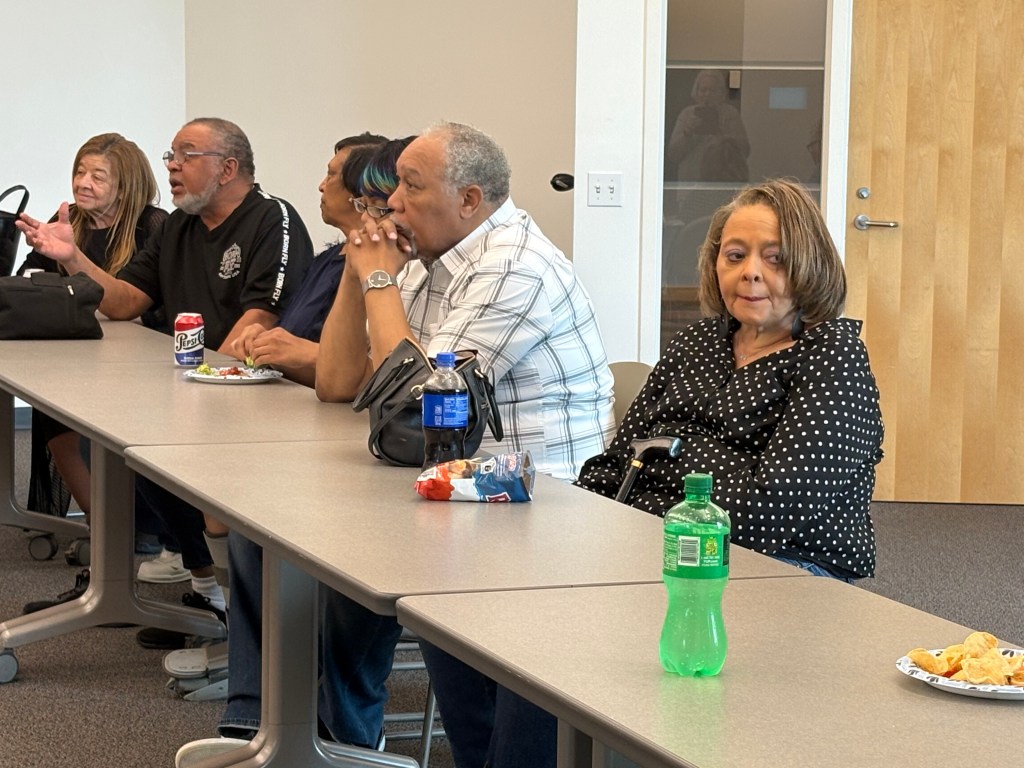
L-R Ann Thomas, Keith Crumes, Flora Crumes, Brenda Davis, Tony Love and Barbara Love, are all descendants of those buried at Smith Chapel Cemetery in Foristell, Missouri.

In 1998, legislation titled the National Underground Railroad Network to Freedom Act of 1998, was passed, creating the Network to Freedom program. Through collaboration with local, state and federal entities, as well as individuals and organizations, its mission is to honor, preserve and promote the history of resistance to enslavement through escape and flight, which continues to inspire people worldwide. Through its mission, the Network to Freedom helps to advance the idea that all human beings embrace the right to self-determination and freedom from oppression. The program is a catalyst for innovation, partnerships, and scholarship that connects and shares the legacy of the Underground Railroad across boundaries and generations. The program consists of sites, locations with a verifiable connection to the Underground Railroad; programs, with educational and interpretive programs that pertain to the Underground Railroad; and facilities, either research, educational or interpretive centers.

The Underground Railroad is one of the most remarkable stories in American history. This is a story of ordinary men and women coming together in harmony, united to pursue the extraordinary mission of helping those in their journey to freedom. This movement, which thrived from the late 18th century through the Civil War, was a testament to the power of unity, courage, and a shared commitment to liberty. The Underground Railroad—the resistance to enslavement through escape and flight, through the end of the Civil War—refers to the efforts of enslaved African Americans to gain their freedom by escaping bondage. Wherever slavery existed, there were efforts to escape. These acts of self-emancipation labeled slaves as “fugitives,” “escapees,” or “runaways,” but in retrospect “freedom seeker” is a more accurate description. Many freedom seekers began their journey unaided and many completed their self-emancipation without assistance, but each subsequent decade in which slavery was legal in the United States, there was an increase in active efforts to assist escape.
Featured

Bringing the story alive

Smith Chapel AME Church and cemetery was established by nine African American families in 1871. Three of the families, those of Benjamin Ogelsby, Smith Ball, and Martin Boyd had joined the U.S. Colored Troops, by escaping their enslavers, via the Underground Railroad. Today the Cemetery is all that remains and is listed on the National Underground Railroad Network to Freedom.

In 2025, the Wesley-Smith Church in Wright City was awarded a grant from the National Park Service’s Network to Freedom to restore this historic Cemetery working with a local preservationist. The grant is also bringing students from the St. Charles Community College together in their American History Class, as a Service Learning Project to collect Oral Histories, do research, and apply for Veterans headstones. In addition to these projects the students also work at the cemetery, cleaning and restoring the headstones that are found there.

By the end of the year, all of this will result in four signs, to be located at the cemetery and funded by the grant. One sign will share the history of the cemetery, one will tell the story of the former Douglass School, the black schoolhouse that was formerly located at the sight, and one will tell the story of Smith Chapel AME church. A fourth sign will share the names of over 100 people, many of which are veterans, that are buried in the Cemetery, but do not have headstones. A tribute to all of their stories, because as long as a name is heard, their story shall be remembered.

We invite you to a program at the Scenic Regional Library in Warrenton on Tuesday, May 6, 2025 at 6 pm which is located at 912 State Hwy 47. For more information see https://scenicregional.librarycalendar.com/event/adult-library-program-1103

Featured

News Update

In January 2025, the historic Smith Chapel Cemetery was awarded a grant from the National Park Service Underground Railroad Network to Freedom. The Project Director is Dorris Keeven-Franke, working with Barbara Love from the Wesley-Smith Church in Wright City, Grace Moser from the St. Charles Community College, and Jerry Prouhet, a professional cemetery restorer. The grant of $16,000 is for the work of Prouhet to restore and clean headstones in the cemetery and signs to be placed at the cemetery. This Grant includes the research by the students at St. Charles Community College’s Service-Learning American History Class.

The students involved are in Moser’s class, and meet regularly with Keeven-Franke, and work with Prouhet in the cemetery, receiving hours of credit for this project. The research involving the students, including Oral History interviews with the families of Smith Chapel Cemetery, will provide the information that will be shared on four signs that are funded in this Grant, placed at the site. One sign will be at the front entrance and share the property’s history, one sign will be at the original site of the Douglass Schoolhouse (which has been moved to Oglesby Park) one sign will be placed where the Chapel once stood, and a sign will also be placed at the cemetery. The costs of the signs are covered in the balance of that grant.

Students are working on research of the families buried in the cemetery and have added to the history already! The sign that will be placed at the cemetery will include ALL of the names of those buried there, so that they may now be recognized. Not all burials have headstones. The students are also working to have military headstones placed at the graves of the many veterans buried in the cemetery. All of this is happening because of the Grant  AND because Smith Chapel Cemetery is listed on the National Underground Railroad Network to Freedom.

Upcoming Events:

Saturday, April 26, 2025 9am-12 noon, students will be working at the cemetery under the direction of Jerry Prouhet. The public is welcome.

Tuesday, May 6, 2025, Project Director Dorris Keeven-Franke will be at the Warrenton Scenic Regional Library in Warrenton on Hwy 47, at 6pm to share the history of the Cemetery and the project. The public is welcome.

Wednesday, May 7, 2025, The students will be presenting their research and sharing with their families, and have invited members of the Church as well.

Any questions about this project can be addressed to Dorris Keeven-Franke at 636-221-1524 or by emailing her at dorris.keevenfranke@gmail.com or by going to the website https://smithchapelcemetery.com/ for more information about Smith Chapel Cemetery. For more information about the National Underground Railroad Network to Freedom can be found at the https://www.nps.gov/subjects/undergroundrailroad/network-to-freedom.htm website.

Featured

Smith Chapel Cemetery

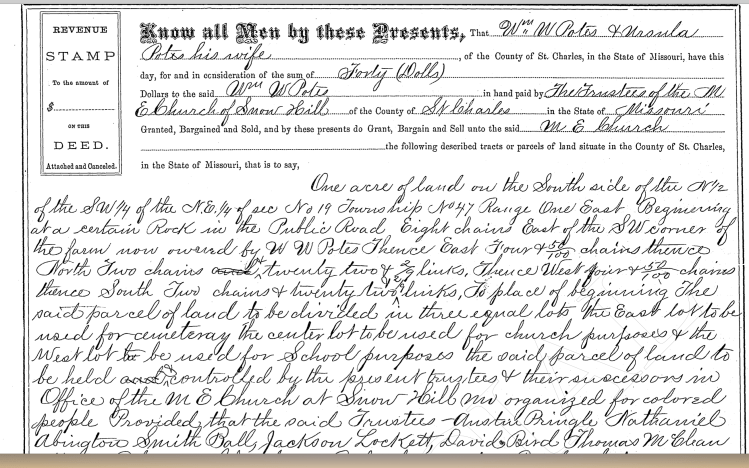
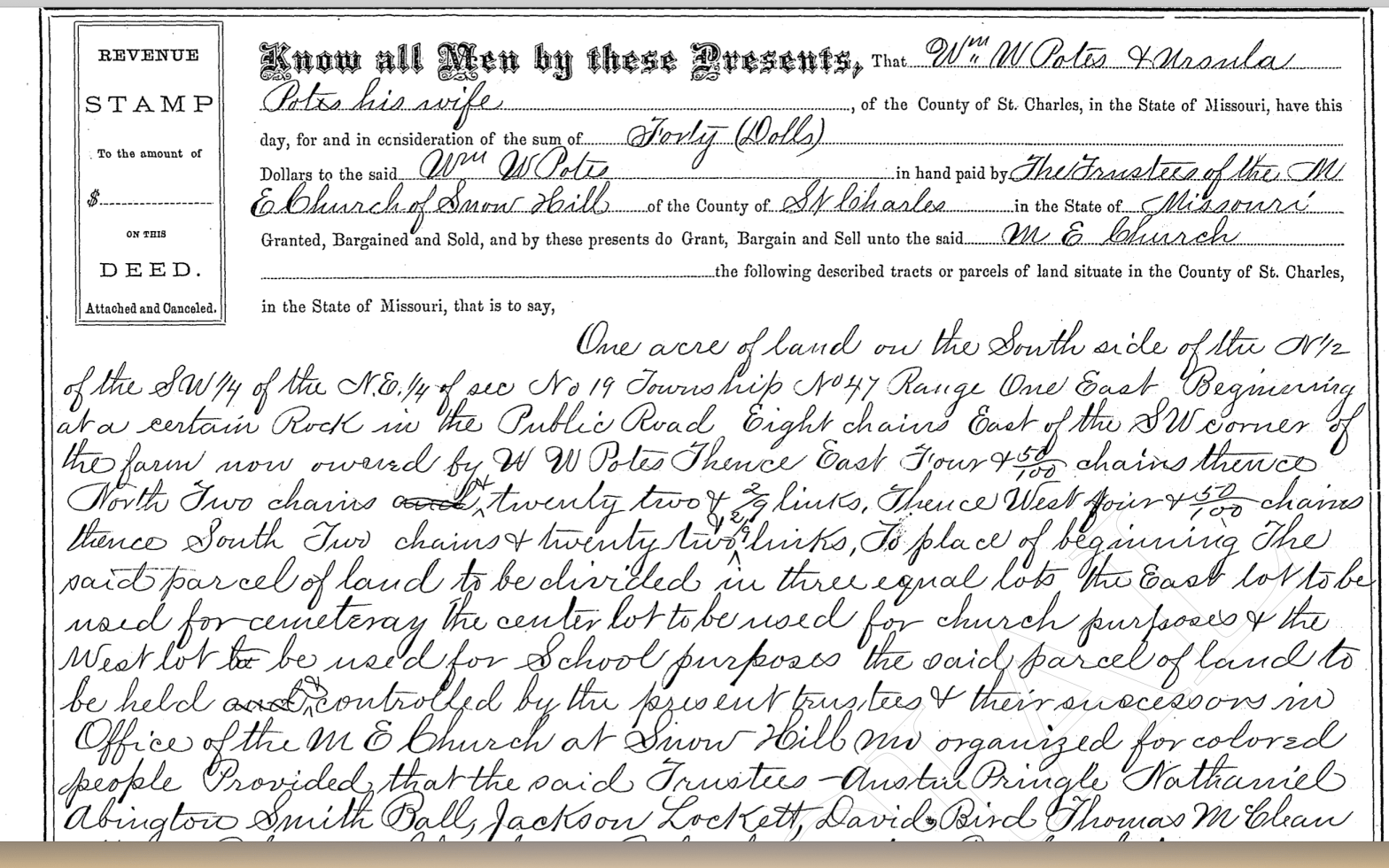
In 1871, several freedom seekers who had fought in the U.S. Colored Troops in the Civil War had returned home. These resilient men, would pool their funds, and establish an African Methodist Episcopal Chapel, with a Circuit rider preacher, that spread the gospel between St. Charles and Jonesburg at that time, and name it Smith Chapel. They would purchase one acre of land from another Union soldier, a German man from Ohio named William Potes, and his wife Ursala, for forty dollars. They would establish that one-third of that acre would be used for the Chapel, one-third would be for the cemetery to bury their loved ones, and one-third would be for the establishment of a schoolhouse named Douglass for their children.

St. Charles County Recorder of Deeds

The Smith Chapel Cemetery is an African American burying ground established by nine formerly enslaved individuals in St. Charles County Missouri. At least three men were freedom seekers, and members of the Smith Chapel African Methodist Episcopal Church associated with this graveyard. The cemetery is final resting place for Smith Ball (1833-1912), Benjamin Oglesby (1825-1901), and Martin Boyd (1826-1912) who each took steps toward freedom and joined the United States Colored Troops, despite the risks involved for themselves and their families. Living in a border state, these families were caught between the conflict of both Union Troops and Confederate guerilla soldiers. Under Martial law, many Missourians strongly opposed the formation of Colored Troops, only allowing those enslaved to serve as substitutes in their place and to fill County quotas. These freedom seekers, like many others, escaped slavery by the underground railroad, enlisting without permission. Slave Patrols, who kept constant watch of the roads for those attempting freedom, would either return those seeking their freedom to their former enslaver or enforce methods of punishment, which could include death. After the war, these men returned to their families to join others in creating this community.

Photo by Dorris Keeven-Franke

Go back

Your message has been sent

Warning.
Warning
Warning
Warning

Featured

History of the Cemetery

Established in 1871, Smith Chapel Cemetery is an African American burying ground established by nine formerly enslaved individuals in St. Charles County Missouri. At least three men were freedom seekers, and members of the Smith Chapel African Methodist Episcopal Church associated with this graveyard. The cemetery is final resting place for Smith Ball (1833-1912), Benjamin Oglesby (1825-1901), and Martin Boyd (1826-1912) who each took steps toward freedom and joined the United States Colored Troops, despite the risks involved for themselves and their families. Living in a border state, these families were caught between the conflict of both Union Troops and Confederate guerilla soldiers. Under Martial law, many Missourians strongly opposed the formation of Colored Troops, only allowing those enslaved to serve as substitutes in their place and to fill County quotas. These freedom seekers, like many others, escaped slavery by the underground railroad, enlisting without permission. Slave Patrols, who kept constant watch of the roads for those attempting freedom, would either return those seeking their freedom to their former enslaver or enforce methods of punishment, which could include death. After the war, these men returned to their families to join others in creating this community.

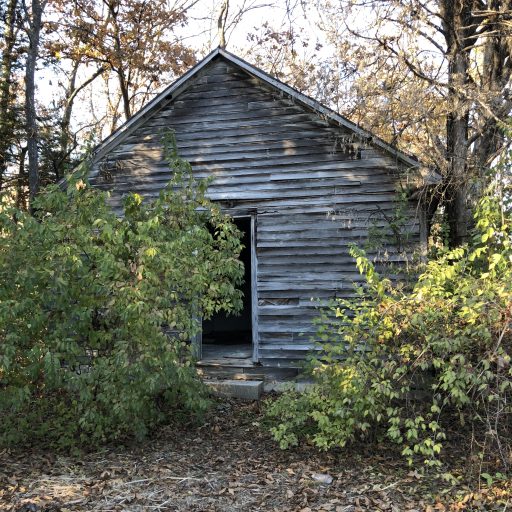
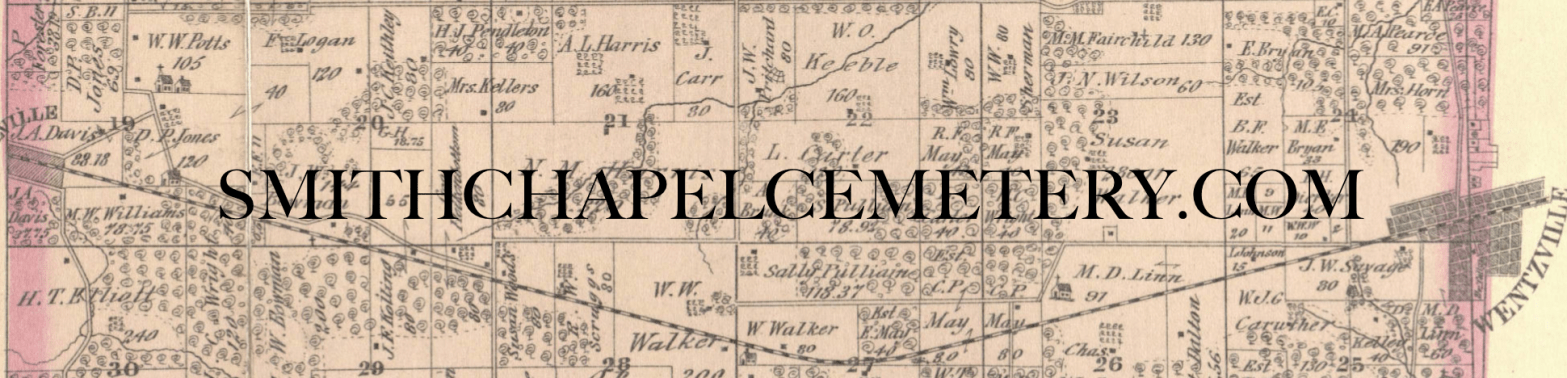
Today, the cemetery is loved and maintained by a community of members from the neighboring Wesley-Smith Chapel in Wright City Missouri. The first church building built in the mid-1800s fell victim to a fire sometime in the late 19th Century. The original schoolhouse named Douglass School, that had been built by 1870, was replaced in the early 1900s. By the end of the 20th Century the schoolhouse, which had not been used since desegregation in the early 1960s, had fallen into disrepair and was being vandalized. That school building was used to re-erect a Douglass Schoolhouse which is in St.Charles County Parks system now. Located in Ogelsby Park, one mile from the cemetery, is the former Oglesby farm, a freedom seeker and a member of the Smith Chapel Church who is buried at Smith Chapel Cemetery.

The Cemetery is listed on the National Underground Railroad Network to Freedom and has received a grant for signage for the cemetery, and repair to broken and fallen headstones. Students from the St. Charles Community College are working to collect oral histories and family photos associated with the property. Please follow all of the latest news at the website https://smithchapelcemetery.com/ or contact us by email at stcharlescountyhistory@gmail.com

Featured

Memorial Day 2024

Due to unfortunate circumstances, the Memorial Day ceremonies planned for May 27th, 2024 have had to be postponed.

Memorial Day was formerly known as Decoration Day when families would visit the graves of their loved ones and honor those who have served our country. Both heroes and those unknown, we use this day to recognize their contributions. Young, old, black, white, and even those who were foreign-born, they answered the call and gave the ultimate sacrifice to make this day possible. As we place our flags and our memorials to their lives, let us not forget their stories.

In St. Charles County, Missouri, Smith Chapel Cemetery is a small cemetery on one-third of the one-acre parcel of land, that was established in 1871, by several African American families, along with the Smith Chapel A.M.E. Church, and a schoolhouse named Douglass. The cemetery, though small, is filled with stories. At least six of the 115 graves that are located there are veterans of the U.S. Colored Troops who served in the Union in the Civil War. And as at least half of those were freedom seekers, who defied their enslavers and risked their lives, to enlist and serve in the Union Army. And, because of this, Smith Chapel Cemetery is now listed on the National Underground Railroad Network to Freedom. This National Parks program lists over 750 sites across our country that “consists of sites, locations with a verifiable connection to the Underground Railroad; programs, with educational and interpretive programs that pertain to the Underground Railroad; and facilities, either research, educational or interpretive centers.”  Today we honor Smith Ball, Martin Boyd, and Benjamin Oglesby, as we honor all our heroes this Memorial Day.

On Sunday, February 28, 1864, thirty-one-year-old Smith Ball made his way from one end of St. Charles to the other, about 25 miles, and to freedom. The Ball farm was located at Flint Hill, also in Cuivre Township, a community just over seven miles east of Snow Hill, today’s Foristell. He would muster in at Benton Barracks in St. Louis like hundreds of other troops and serve in Company B of the 68th US. Colored Troops. He was one of the original Trustees of Smith Chapel and is buried there.

On October 31, 1864, freedom seeker Martin Boyd, left the 300-acre plantation of Alexander Boyd and tried to make his way to George Senden’s store on Main Street in St. Charles, only to make seven miles to the Peruque Creek Fort at the Missouri Railroad Bridge. Nearly caught, the young man was anxious to serve in the Union Army. He would serve in Company B of the 49th United States Colored Troops, until March 22, 1866. Boyd was also a Trustee of Smith Chapel and is buried there.

On November 14, Benjamin Oglesby and several other St. Charles County slaves left their owners and enlisted in the U. S. Colored Troops at George Senden’s store on Main Street, in what was known as “the Rendezvous”. This was part of the Union Army’s campaign in 1864 to recruit Missouri’s fugitives, refugees, and contraband into the Union’s ranks. That day it also netted over 30 men and freedom seekers from the nearby Hopewell Baptist Church. Oglesby was formally mustered into Company D as a Private of the 56th Infantry of the Union’s U.S. Colored Troops, at Benton Barracks. Unlike over 175 fellow soldiers from the 56th, Oglesby would return to his wife and family, and be buried at Smith Chapel. His son-in-law, Jackson Luckett was also one of the original trustees, that would build the Douglass schoolhouse for their children.

The 56th U.S.C.T. would see action in expeditions that took them from Helena, Arkansas up the White River to Friar’s Point, Mississippi.  They had post and garrison duty at Helena, Arkansas till February of 1865. After the war ended, they continued to have duty at Helena till September 1866, when they assisted the local families, who were Quakers, build Southland University. The entire regiment was finally completely mustered out on September 15, 1866. The Regiment lost four Officers and twenty-one enlisted men who were killed or mortally wounded, and they lost two Officers and 647 Enlisted men by disease.”  Many of those died going home, like George [Granville] Abington, (ancestor of another George Abington, his namesake) who was buried first at Quarantine Island and then moved to Jefferson Barracks National Cemetery. For more about the 56th USCT see https://www.facebook.com/56USCT online.

Let us not forget the true meaning of this day, and the hardships and sacrifices of those who have served our country, in peacetime and in war, and allow us to celebrate their lives. For more about the National Underground Railroad see https://www.nps.gov/subjects/undergroundrailroad/network-to-freedom.htm for more information. Douglass Schoolhouse is now located in St. Charles County Parks and is also on the National Underground Railroad Network to Freedom.

Smith Chapel Cemetery also has a Facebook Page we urge you to follow: https://www.facebook.com/Smithchapelcemetery/

Featured

National Underground Railroad

Smith Chapel Cemetery, an African American cemetery in Missouri, was established in 1871 and is the resting place of freedom seekers who fled from their enslavers and served in the U.S. Colored Troops.  In 1864, Smith Ball (1833-1912) escaped to St. Charles on February 28th and enlisted in the 68th U.S. Colored Troops. Benjamin Oglesby (1825-1901) fled his enslaver and enlisted on November 14, 1864, in the U.S. 56th U.S. Colored Troops. On October 31, 1864, Martin Boyd (1826-1912) took steps towards freedom and joined the Union troops guarding Fort Peruque, enlisting in the 49th U.S. Colored Troops. After the Civil War, upon returning home to their families, these veterans along with Oglesby’s son-in-law Jackson Luckett, Nathaniel Abington, Austin “Oss” Pringle, David Bird, Thomas McClean, Mark Robinson, and Claiborne Richards, were the first Trustees of the Smith Chapel African Methodist Episcopal Church at Snow Hill. This one-acre of land included a one-room black schoolhouse named Douglass and a small Church building for worship. Though the schoolhouse has been relocated to Oglesby Park, and the church building no longer stands, Smith Chapel Cemetery remains an important landmark for many of the descendants of the freedom seekers and their families today.

Beginning in the 17th century and continuing through the mid-19th century in the United States, enslaved African Americans resisted bondage to gain their freedom through acts of self-emancipation. The individuals who sought this freedom from enslavement, known as freedom seekers, and those who assisted along the way, united together to become what is known as the Underground Railroad. The National Park Service and members of the Network to Freedom tell these stories of escape to demonstrate the significance of the Underground Railroad in the eradication of slavery as a cornerstone of the national civil rights movement.

[see https://www.nps.gov/subjects/undergroundrailroad/national-park-service-announces-19-additions-to-the-underground-railroad-network-to-freedom-in-10-states.htm]

Featured

Smith Ball

Buried at Smith Chapel A.M.E. Cemetery in Foristell is Smith Ball, one of the nine Trustees who helped start the A.M.E. church in 1871.

On Sunday, February 28, 1864, thirty-one-year-old Smith Ball had made his way from one end of St. Charles County to the other, a distance of about 25 miles, to reach freedom. His enslaver was John Ball who had passed away in 1850, leaving fifteen enslaved people living in three small cabins on his widow, Ann Hitch Ball’s large tobacco plantation.[ii] The Ball farm was located at Flint Hill, also in Cuivre Township, a community just over seven miles east of Snow Hill. 

Smith Ball had been born May 26, 1833[iii], in Virginia, and had been brought to Missouri during the 1830s.  According to his enlistment papers, he was a light-colored black [man], 5 foot 10 inches tall, with brown eyes and black hair.  When he enlisted, he left behind a wife Minerva Pringle, and four children, William, Lucy, John H., and Ada. When mustered in at Benton Barracks, he was examined by John Bruere, MD. of Benton Barracks in St. Louis like hundreds of other troops. He served in Company B of the 68th US. Colored Troops. [iv] The remarks on the Descriptive list stated “Recruit presented himself” meaning that he had fled his enslaver, Ann Hitch Ball(1804-1870), the widow of John P. Ball (1805-1858)[v].


Notes

[ii] 1850 U.S. Federal Census – Slave Schedules Record, United States of America, Bureau of the Census. Seventh Census of the United States, 1850/i. Washington, D.C.: National Archives and Records Administration, 1850. M432

[iii] MO Secretary of State, Bureau of Vital Statistics, Death Certificate of Smith Ball, Sept. 13, 1912.

[iv]Compiled Military Service Records of Volunteer Union Soldiers Who Served the United States Colored Troops: 56th-138th USCT Infantry, 1864-1866; NARA; 300398; Carded Records Showing Military Service of Soldiers Who Fought in Volunteer Organizations During the American Civil War, compiled 1890 – 1912, documenting the period 1861 – 1866

[v]  The 1860 U.S. Federal Slave Schedule for Ann Ball, Cuivre Township, St. Charles County.

Featured

Freedom Seeker Martin Boyd

Union Troops at Fort Peruque on the North Missouri Railroad
Born on the Boyd Plantation – Now Towne Park in St. Charles County Parks

STORIES OF SMITH CHAPEL CEMETERY

Featured

Benjamin Oglesby and the U.S. Colored Troops

His children, grandchildren, and future generations would attend Douglass School, a segregated African American schoolhouse, which has been removed to Ogelsby Park, part of St. Charles County Parks & Recreation.

Next: Smith Ball and the 68th U.S. Colored Troops


Sources:

[i] The 1860 U.S. Federal Slave Schedule on Page 5 lists Marshall Bird as owning eight enslaved individuals living in 2 buildings, which indicates that Benjamin and his wife Patsy and their children had their own cabin. See attached.

[ii] Marshall Bird Land Patent 1837, Bureau of Land Management General Land Office Records, Certificate #14734 of the U.S. Land Office shows that Marshall Bird also lived in Section 19, the NW ¼ of the NW1/4 of Sect. 19, Twnshp 47 North Range 1 East. See Attached