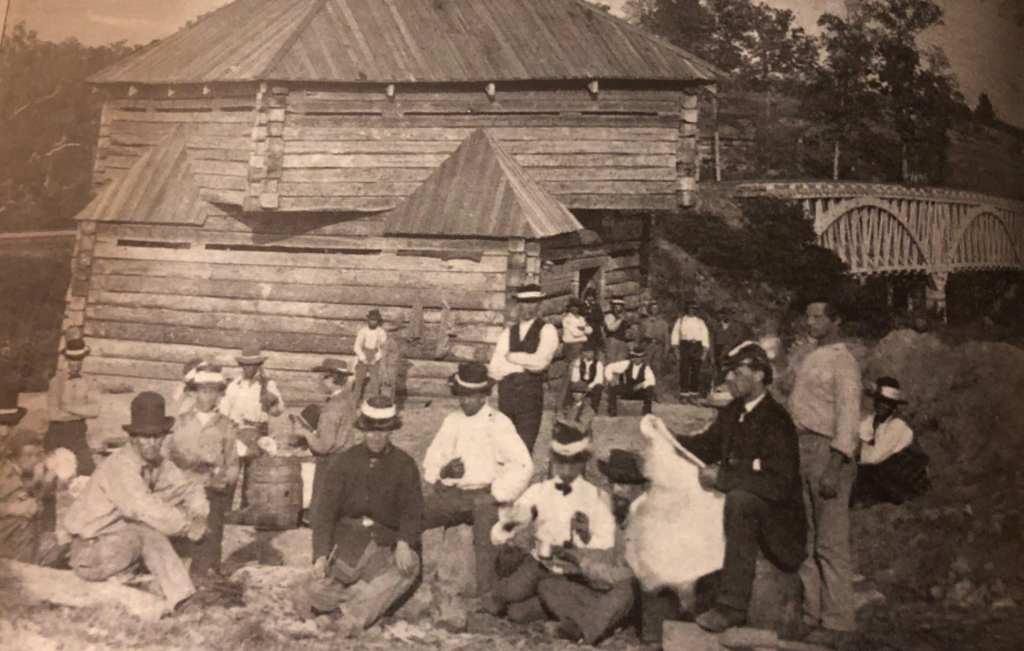
On October 31, 1864, freedom seeker Martin Boyd, born in 1826, left the 300-acre plantation of Alexander Boyd and tried to make his way to George Senden’s store on Main Street in St. Charles, only to make it as far as Peruque Creek Fort at the Missouri Railroad Bridge. There Capt. L.D. Jay would enlist the 5’9” black man into the U.S. Colored Troops. Later, Alexander Boyd tried to show proof that he had inherited Martin from his mother Ruth Carr Boyd, widow of William Boyd, and that Martin Boyd was his property, and was seeking compensation for Martin’s Services and that as such he was entitled to a $300 bounty. Alexander did not receive it. Freedom seeker Martin Boyd would serve in Company B of the 49th United States Colored Troops, until March 22, 1866. That December 31st, 1866, he would marry Mandy (is this Amanda?) Logan, as Black Marriages were now legal.
Born on the Boyd Plantation – Now Towne Park in St. Charles County Parks
In 1827, Missouri was a new state filled with opportunity, at least for some people. Those living in Maryland, Kentucky, and Tennessee saw the opportunity and seized upon it. The land was selling for $1.25 an acre or if it already had “improvements” a man could get at least $2 per acre. And Dardenne and Cuivre Townships of St. Charles County were huge prairies where the crops of tobacco and hemp could make a man richer than his wildest dreams. William Boyd from Shelby County Kentucky had such a dream when he investigated it, but would die in 1830, before he could fulfill it, leaving behind his wife of 32 years, Ruth Carr, mother of his 11 children. When Ruth’s father died in 1832, she brought her children and joined her brother James and his wife Susanna, who had already settled in Flint Hill. With Ruth was her 10-year-old son Alexander Thomas Boyd and at least eleven enslaved individuals.
In 1840, Mrs. Boyd, now living in Cuivre Township, had 14 enslaved individuals living here and working on her plantation. By 1850, the number of these enslaved individuals had grown even larger to 17 African Americans living on the Boyd plantation. The youngest is now an 11-month-old boy, and the oldest is now a 44-year-old woman, among the 8 females and 9 males on the tobacco farm. Unfortunately, the 1850 Census taker did not take the number of buildings there were to house these individuals, and their names were never given. The accounting of this is all based on an honor system, for tax purposes only.
By 1860, Ruth Boyd 78-year-old mother of Alexander Boyd, is living with her son, next to her son Thomas, on the Boyd family plantation. Ruth is the enslaver of 7 people living in two cabins, Alexander has 8 people living in one cabin, and Thomas has 7 people as well living in two cabins. In all, this Flint Hill tobacco farm has 22 enslaved people living in 4 cabins, which range from a pair of 5-month-old twin girls to a couple of women who are estimated to be 30 years old. No, the 1860 Federal Census, never gives us names of all of these people. But according to records, St. Charles County Park historian Ben Gall shares the names of 14 of these 22 people. They are Martin, Amanda, Henry, Lucy, Thomas, Emeline, Ella, David, Maria, her daughter Maria, Rose, Joshua, George and Ruth. The Boyd Plantation is now Towne Park, part of the St. Charles County Park System.
In 1870, the United States Census revealed so much. Forty-eight-year-old Alexander T. Boyd, and his wife Ann Medora (McRoberts), are still living on the Boyd plantation, with their three children, Fannie aged 13, William aged 12, and 2-year-old Fenton. With them live white 26-year-old Henry Minor and his 30-year-old wife Mary, who works as a farmhand for Alexander. Martin lives on the plantation with his wife Mandy, and their 1-year-old son Samuel. In 1912, 86-year-old Boyd passed away and was buried in the Smith Chapel Cemetery.
STORIES OF SMITH CHAPEL CEMETERY
In 1871, several veterans of the U.S. Colored Troops returned home to their loved ones and began building a new life in freedom. Nine men, Austen Pringle, Nathaniel Abington, Smith Ball, Jackson Lockett [Luckett], David Bird, Thomas McClean, Mark Robinson, Claiborn Richards, and Martin Boyd would come together as trustees for the Smith Chapel A.M.E. in what is today’s Foristell. For $40, they purchased a small one-acre of land to start a school for their children named Douglass, build an African Methodist Episcopal Church named Smith Chapel for their families, and establish a cemetery for their loved ones. Of the over 115 burials in the Smith Chapel Cemetery, at least ten veterans of the U.S.C.T. Many of these men had been brought to St. Charles County, from Virginia and Kentucky. Some had been born here, some had families here, but all had been enslaved here. Many of them have families that still live here today.

 Smith Chapel Cemetery
One thought on “Freedom Seeker Martin Boyd”
Comments are closed.