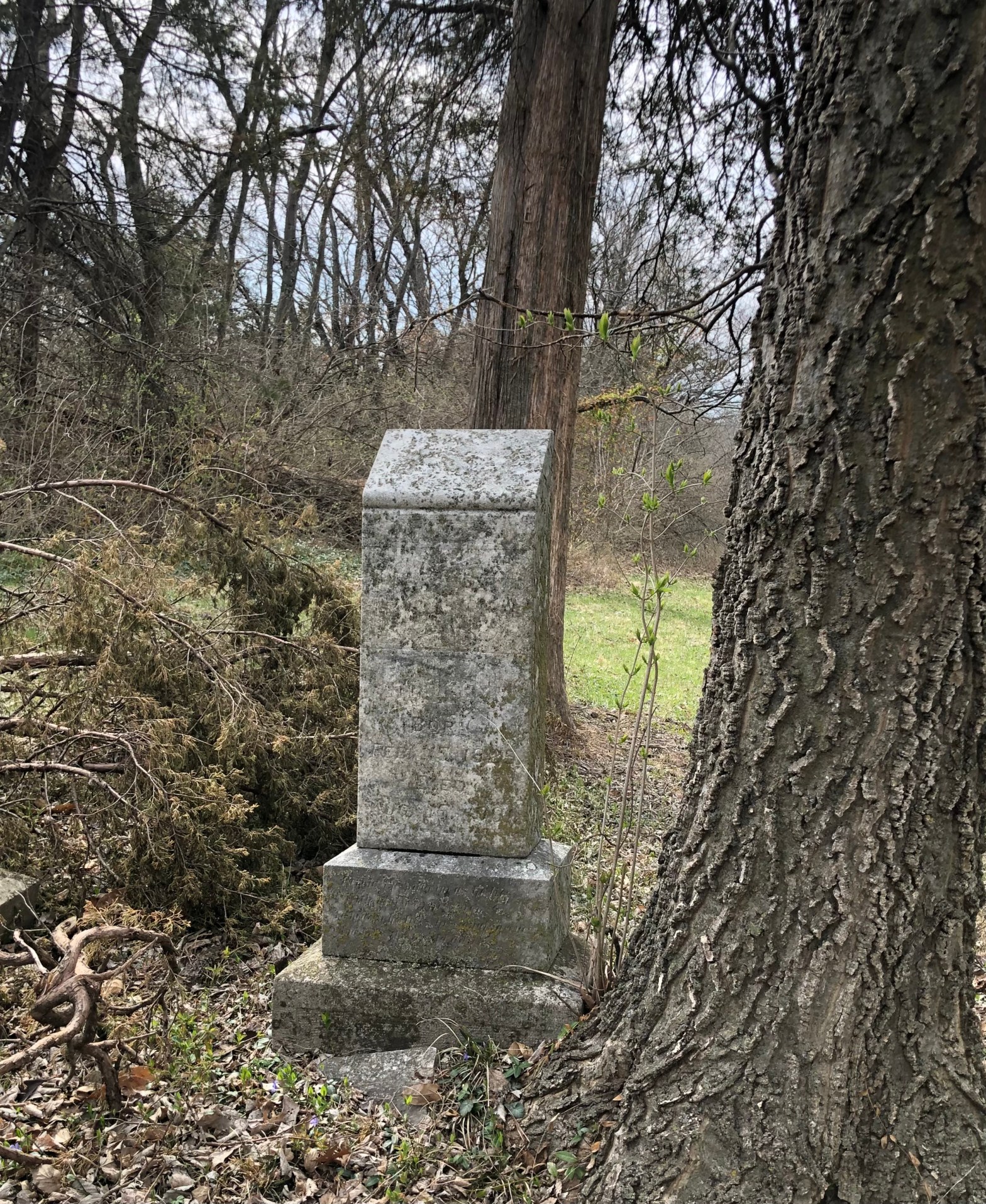
In 1871, several formerly enslaved St. Charles County men returned home, as veterans of the U.S. Colored Troops of the Union Army, and began building a new future for their families. For $40, they purchased a small one-acre of land from a German veteran, to start a school for their children named Douglass, build an African Methodist Episcopal Church named Smith Chapel for their families, and establish a cemetery for their loved ones. Of the over 115 burials that lie in the Smith Chapel Cemetery, there are at least ten veterans of the U.S.C.T. Many of these men had been brought to St. Charles County, from Virginia and Kentucky. Some had been born here, some had families here, but they all had been enslaved here. Many of them have families that still live here today.
On November 14, 1864, freedom seeker Benjamin Oglesby* fled Marshall Bird’s[i] farm[ii] at Snow Hill and made his way the thirty-five miles to St. Charles. Oglesby had been born in Bedford County, Virginia in about 1821 at the home of his mother’s enslaver, Marshall Bird. Benjamin was brought to Missouri by Bird as a young boy, around 1830. Bird’s farm was at the far western edge of the St. Charles County border with Warren County, near the Post Office called Snow Hill, which later became Foristell. He would work in the fields of Birds’ 100-acre farm, where like so many of Birds’ neighbors, the primary crop was tobacco. In 1860 the farm would produce over 7000 pounds alone. He left behind a wife named Martha*, whom he called Patsy, and together they would have eight children, Dora*, Mary*, Samuel,* Sarah*, Sophia*, Oska*, Albert*, and Belle* who were all born before November of 1864. There were two cabins on Marshall Birds’ tobacco plantation, and David Bird* occupied the other.
He enrolled at the age of 43, being copper-skinned, with grey eyes and black hair, and being 5 feet 8 inches tall. He was formally mustered into Company D as a Private in the 56th Infantry of the Unions’ U.S. Colored Troops at Benton Barracks (near today’s Fairground Park).[iii] His enrollment gives no evidence of Marshall Bird as ever applying for or receiving the $300 bounty. Oglesby’s Regiment was originally Third Arkansas and was the first black regiment recruited in Missouri; it had been raised as an “Arkansas” regiment to avoid offending loyal Missouri slaveholders. In March 1864, it had been re-designated the Fifty-Sixth United States Colored Infantry and sent to Helena, Arkansas. Conditions there were atrocious. Some of the regiment’s companies were sent to Island No. 63, about twenty miles south of Helena on the east side of the Mississippi. Helena was the site of a huge contraband camp, where thousands of formerly enslaved would find refuge during the Civil War. After the war ended, the 56th would help build and establish an African American University and an orphanage. Hiram Luckett, a relative of Benjamin Oglesby died there in a hospital on September 18, 1864, from chronic diarrhea. Many others serving in the U.S. Colored Troops would suffer the same fate.
His children, grandchildren, and future generations would attend Douglass School, a segregated African American schoolhouse, which has been removed to Ogelsby Park, part of St. Charles County Parks & Recreation.
Next: Smith Ball and the 68th U.S. Colored Troops
Sources:
[i] The 1860 U.S. Federal Slave Schedule on Page 5 lists Marshall Bird as owning eight enslaved individuals living in 2 buildings, which indicates that Benjamin and his wife Patsy and their children had their own cabin. See attached.
[ii] Marshall Bird Land Patent 1837, Bureau of Land Management General Land Office Records, Certificate #14734 of the U.S. Land Office shows that Marshall Bird also lived in Section 19, the NW ¼ of the NW1/4 of Sect. 19, Twnshp 47 North Range 1 East. See Attached
[iii] Oglesby, Benjamin National Archives and Records Administration Compiled Military Service Records of Volunteer Union Soldiers Who Served the United States Colored Troops: 56th-138th USCT Infantry, 1864-1866;
For more about the Smith Chapel Cemetery see https://smithchapelcemetery.com/
 Smith Chapel Cemetery
One thought on “Benjamin Oglesby and the U.S. Colored Troops”
Comments are closed.